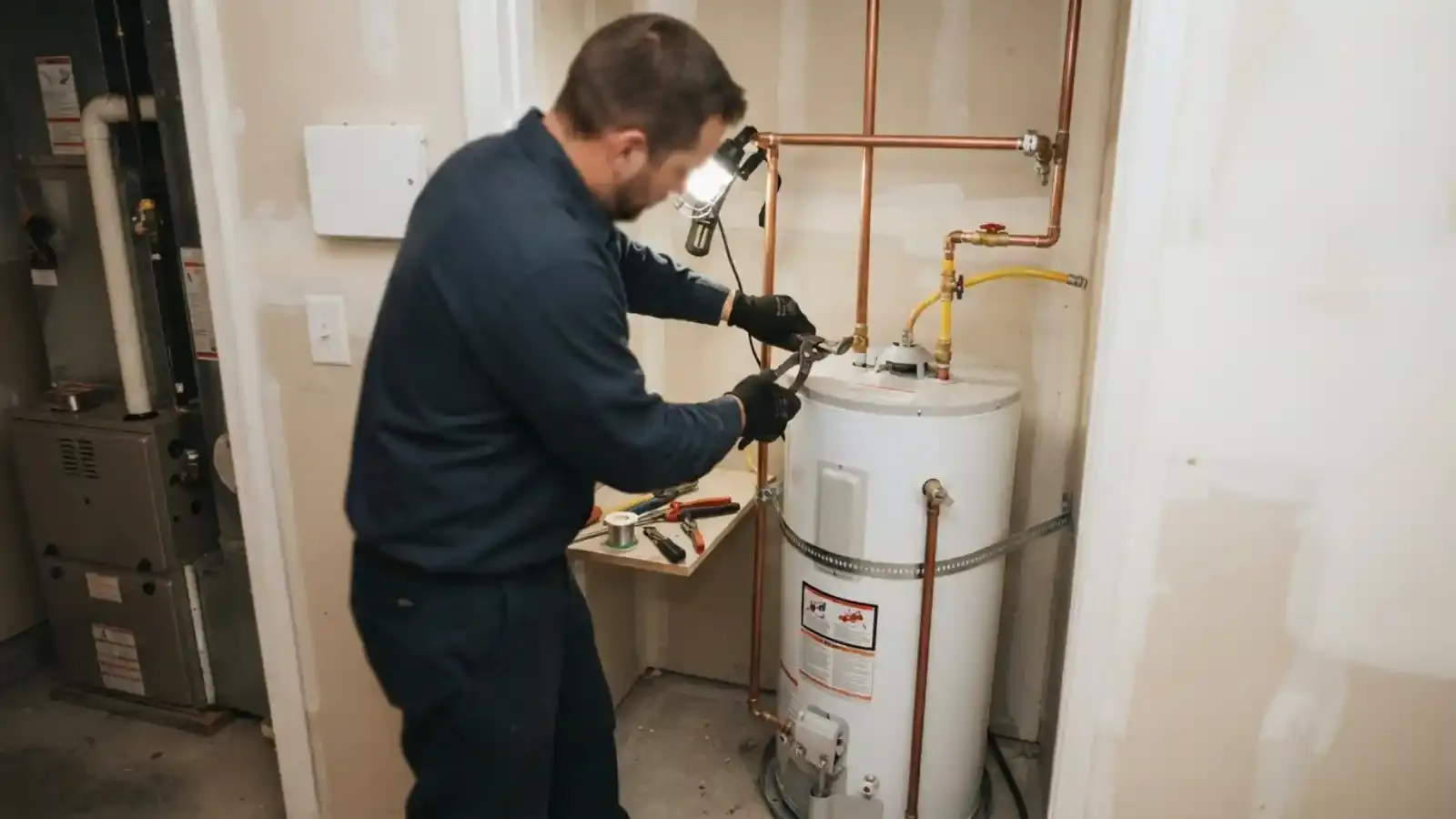
What The Tank Does
An expansion tank is a small steel tank with a rubber bladder inside. One side holds air under pressure, and the other connects to your cold water line near the heater. When heating raises the pressure, the bladder flexes and absorbs the extra volume.
Without it, pressure can spike each time the heater runs. The relief valve may drip or discharge, fixtures may wear out sooner and the heater itself can be stressed.
Signs a closed system needs an expansion tank
- The temperature and pressure relief valve drips or discharges periodically
- Pressure on a gauge climbs when the heater fires and falls when the tap opens
- Banging pipes right after a heating cycle
- Toilets that run or fill valves that fail more often than expected
- A backflow preventer or pressure reducing valve on the main line
Is My System Closed?
| Feature | Why it closes the system | What the plumber checks |
|---|---|---|
| Check valve at the meter | Blocks backflow to the street | Presence and condition |
| Pressure reducing valve | Includes a check function in many models | Setting and downstream pressure |
| Backflow preventer | Required for irrigation or other uses | Type and location |
| Prior expansion tank | Previous installers saw a need | Precharge and condition |
A simple gauge on a hose bib shows static pressure. Watch it while the heater runs. If it rises noticeably, expansion is the cause. The plumber can test and size the tank.
Relief Valve Dripping?
Call the Erie emergency line. We will tell you what to shut off and line up a plumber.
Sizing And Setting The Tank
Measure pressure
Read the static water pressure with a gauge.
Pick the size
Tank size depends on the heater volume and the pressure.
Match the precharge
Set the air side to equal the house water pressure before connecting.
Install and support
Mount the tank on the cold line near the heater with a support strap if the unit is heavy.
The air charge is the detail most often missed. A tank shipped at a default pressure that does not match the house will not work as intended. A plumber checks and adjusts it.
Replacement And Maintenance
A waterlogged tank has lost its bladder or air charge. Tap it, and if it sounds full all the way up, it has failed. Press the air valve too, since water coming out means the bladder broke. Expansion tanks last years but not forever, so check them when you replace a heater.
If you are replacing a heater, see our water heater replacement page. For a relief valve that is dripping now, see water heater repair. We also work in Lafayette. See the Lafayette page and the service area page.
Thermal Expansion And Pressure Limits
Plumbing codes commonly limit static water pressure to 80 psi, and many homes run lower. Thermal expansion can add many pounds of pressure in a closed system within minutes of the heater firing. That is why the relief valve may open even when static pressure looks normal.
The pressure reducing valve is another part of the story. If it fails, supply pressure rises. A gauge on a hose bib helps you see whether the problem is supply pressure or expansion.
Common Mistakes
What goes wrong with expansion tanks
- Installing a tank without matching its air charge to house pressure
- Mounting it so its weight hangs from a copper pipe
- Putting it on the hot side instead of the cold side
- Skipping the shutoff and drain that make future replacement simple
- Never checking it after the first year
A tank that fails does not announce itself. Check it each year with the system off and the pressure relieved. An expansion tank that sounds solid on both ends is waterlogged and needs replacing.
The requirement comes from the plumbing code. The International Plumbing Code (IPC) calls for thermal expansion control where a storage water heater sits in a closed system, so an inspector may ask to see one. Local authorities adopt and amend the code, and the Town of Erie Building Division can tell you which edition applies.
Erie Notes: Licensed Work And Permits
A December 4, 2025 bulletin from the Colorado Department of Regulatory Agencies says the State Plumbing Board requires water heater installs and replacements to be done by a licensed plumber working for a registered plumbing contractor, with permits and inspections from the local authority. Read the bulletin.
In Erie, the Building Division at 303-926-2780 handles permits and inspections. An expansion tank is part of what an inspector reviews with a new heater, so ask the plumber to confirm it is on the permit.
Questions Erie Homeowners Ask
No. It depends on whether the plumbing system is closed. The plumber can check.
On the cold water line near the heater, supported so it does not stress the pipe.
High pressure from thermal expansion is a common cause. A failing valve is another. The plumber tests both.
Many last several years, but the bladder can fail sooner in high-pressure systems. Check it at each heater replacement.
It depends on whether your supply is a closed system. Ask the plumber to check pressure, and confirm with the Town of Erie Building Division at 303-926-2780.