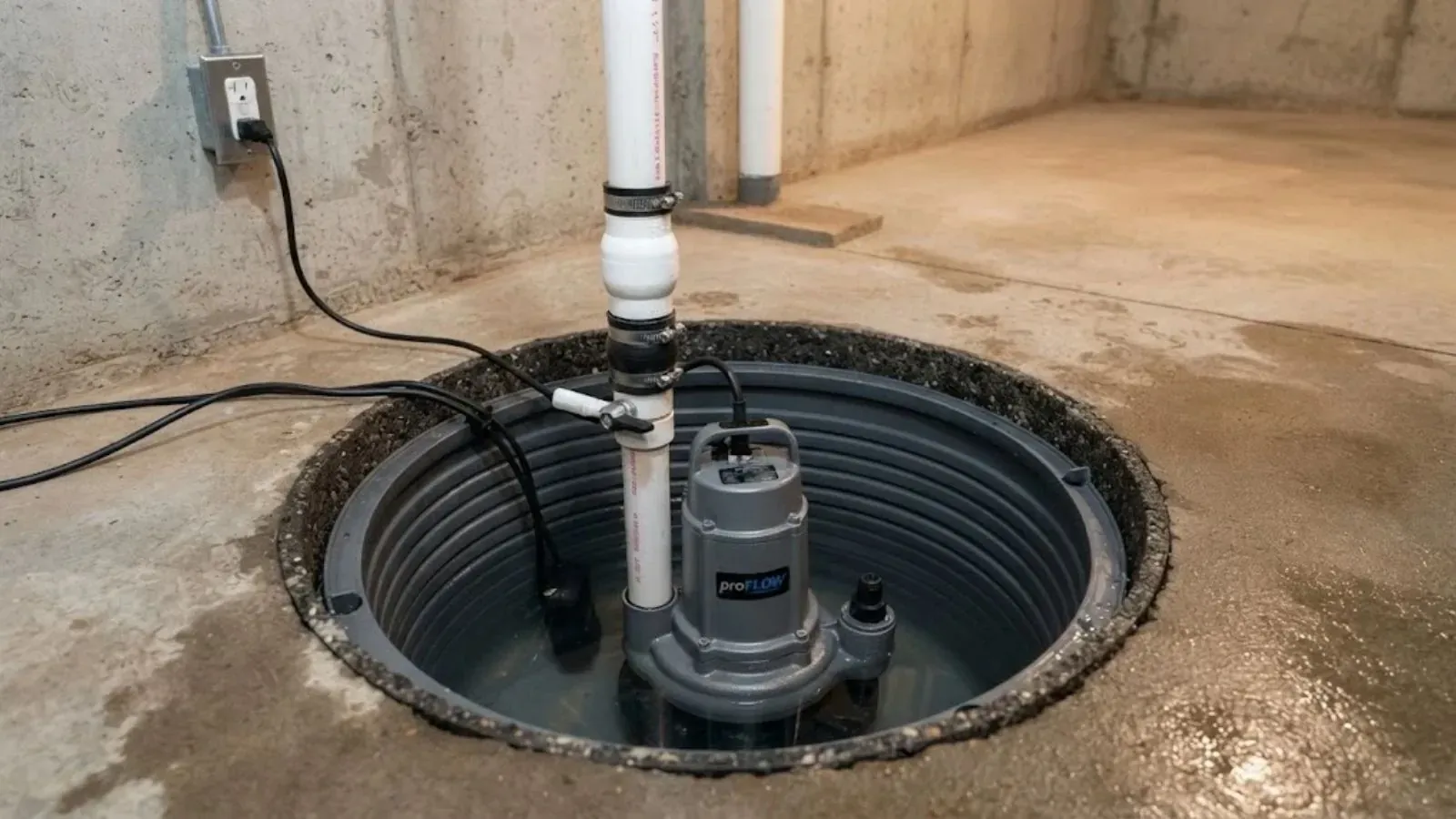
How A Discharge Line Fails
| Problem | Sign | Fix |
|---|---|---|
| Frozen outlet | Pump runs, pit stays full, ice at the pipe end | Thaw safely and add a freeze-resistant outlet |
| Clogged line | Pump runs hard, water flows slowly | Clear the line and check the screen |
| Cracked or separated pipe | Wet ground along the line | Replace the damaged section |
| Backwards or missing check valve | Water falls back and the pump short-cycles | Install or replace the check valve |
| Poor slope | Standing water in the pipe | Regrade the line to drain |
| Discharge too close | Water returns to the foundation | Extend the line farther away |
A pump that cycles every few seconds often has a check valve problem. Water drains back into the pit after each cycle, so the pump has to repeat the work. Replace the valve before you replace the pump.
Where Should The Water Go?
The goal is to move water well away from the foundation, onto ground that slopes away. A discharge that spills next to the wall just recycles the water. Many people extend the line to a lower part of the yard or a drainage swale.
Do not discharge to a neighbor's property. Do not send it onto a sidewalk that will ice. Most places do not allow connecting a sump discharge to the sanitary sewer, because storm water overloads sewers. Ask the Town before you plan a connection.
Pump Running But The Pit Stays Full?
Call the Erie emergency line. We will tell you what to shut off and line up a plumber.
Winter Problems
Preventing a frozen discharge
- Keep the outlet clear of snow and ice
- Use a larger-diameter pipe near the end so ice does not block it
- Slope the line so water drains out after each cycle
- Install a freeze-resistant outlet or a bypass that opens if the end freezes
- Check the line after the first hard freeze
A frozen outlet makes the pump push against a solid block. It can overheat and burn out. Shut off the pump if you suspect a freeze and call a plumber before the pit overflows.
Repair Steps
Find the failure
Run the pump and watch the line, the check valve and the outlet.
Isolate and cut
Cut out the damaged section and note the pipe size.
Replace with matching pipe
Install new pipe with proper couplings and slope.
Test under load
Fill the pit and watch the whole line for leaks and flow.
Our sump pump page covers the pump itself. For recurring water problems, see basement waterproofing. We also serve Lafayette. See the Lafayette page and the service area page.
Choosing Pipe And Fittings
Discharge lines are usually PVC or flexible corrugated pipe. Rigid PVC with glued joints is more durable and holds slope better. Flexible pipe is easy to install but can collect water and freeze in low spots.
Use the size the pump requires, commonly one and a half or two inches. Using a smaller pipe restricts flow and makes the pump work harder. Use proper couplings and cement rather than tape or clamps.
Grading And Outlet Design
A discharge line should slope away from the house so water drains out after each cycle. The outlet should sit above ground level and away from walkways. A splash block or a short pop-up emitter spreads the flow.
Avoid ending the line where water can pool against a neighbor's fence or a driveway. Water that returns to the foundation defeats the purpose of the pump.
Testing After A Repair
Pour water into the pit until the pump starts. Walk the line and watch for leaks and for flow at the outlet. Listen for the check valve closing. A quiet run with water leaving the outlet means the repair worked.
The plumbing code is firm on where this water may go. The International Plumbing Code (IPC) says storm water may not be drained into sewers intended for sewage only, which is why a sump discharge belongs outdoors. Your local authority can confirm its own rules.
Erie Notes: Weather, Soil And Where Water Should Go
NOAA's 1991 to 2020 climate normals put Erie's annual precipitation at 16.17 inches. That is modest, but spring snowmelt and short intense storms deliver water in bursts, which is when pumps and discharge lines get tested.
The Colorado Geological Survey's swelling soils guide says keeping water away from foundations is a main defense in clay soils. A discharge line that ends several feet from the wall, on ground that slopes away, supports that goal.
Questions Erie Homeowners Ask
A frozen or clogged discharge, a failed check valve or a pump with a worn impeller. The plumber checks each.
Several feet at least, onto ground that slopes away. The right distance depends on your lot.
Most places prohibit it. Ask the Town of Erie Building Division at 303-926-2780 before you connect.
Yes, with slope and a freeze-resistant outlet. A buried line can still freeze at its end.
Shut off the pump if the pit is not rising, thaw the outlet safely and call a plumber.